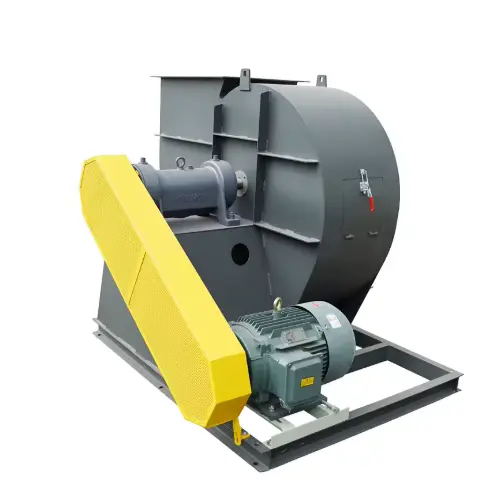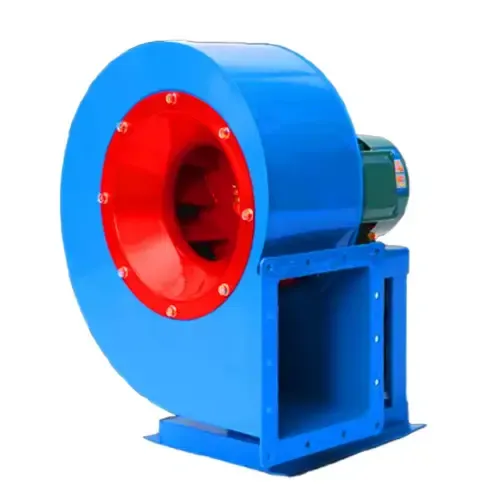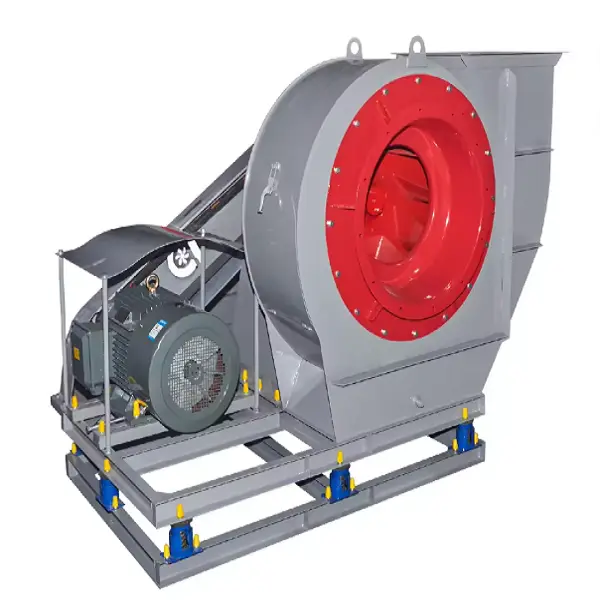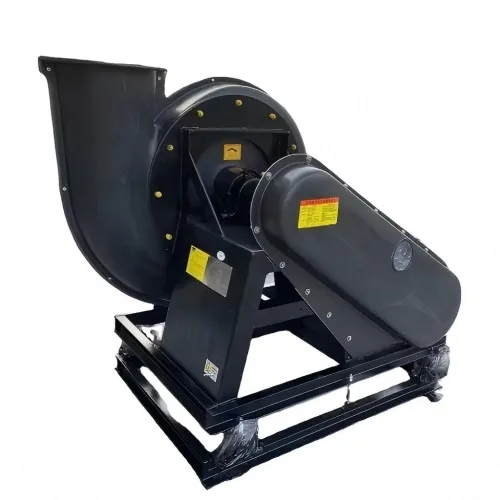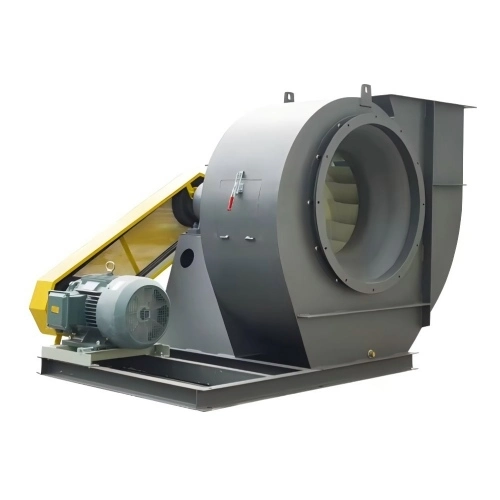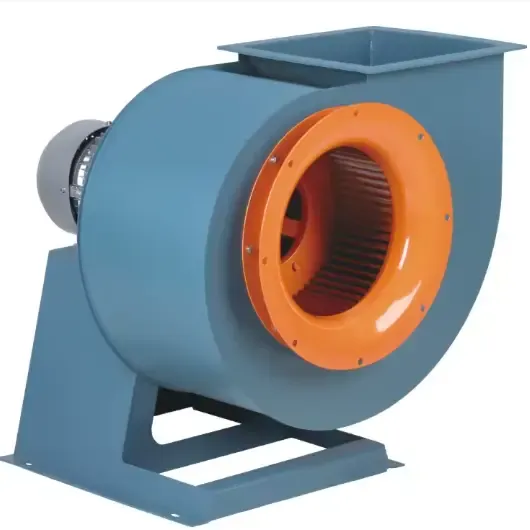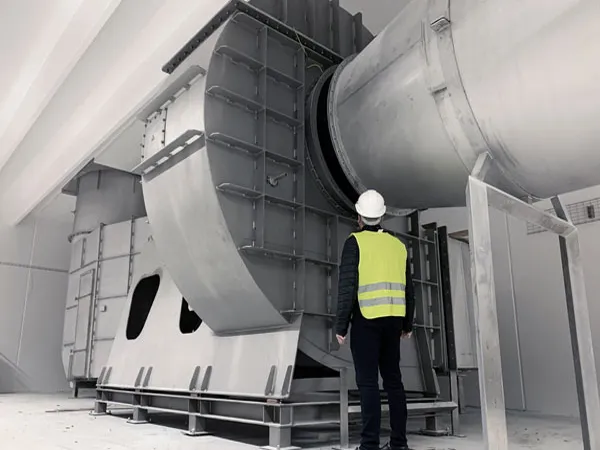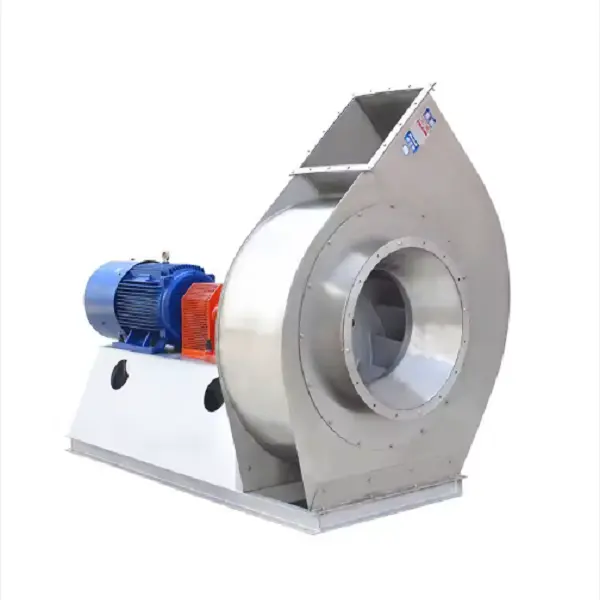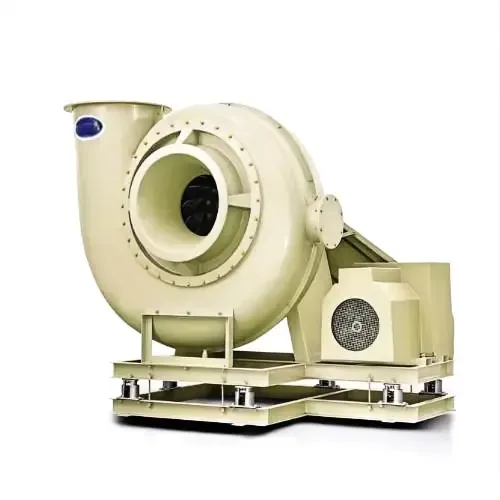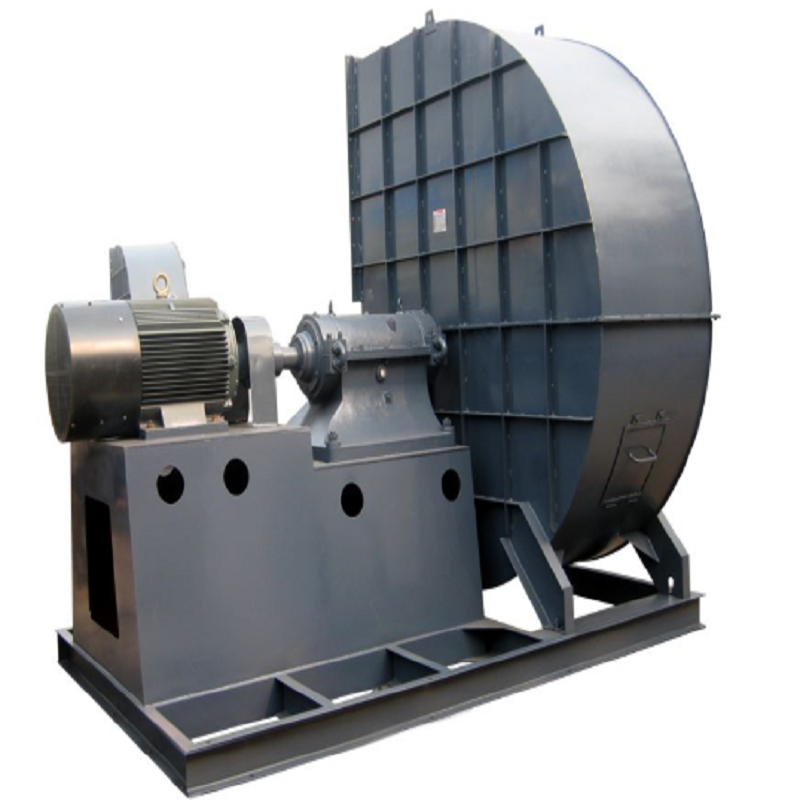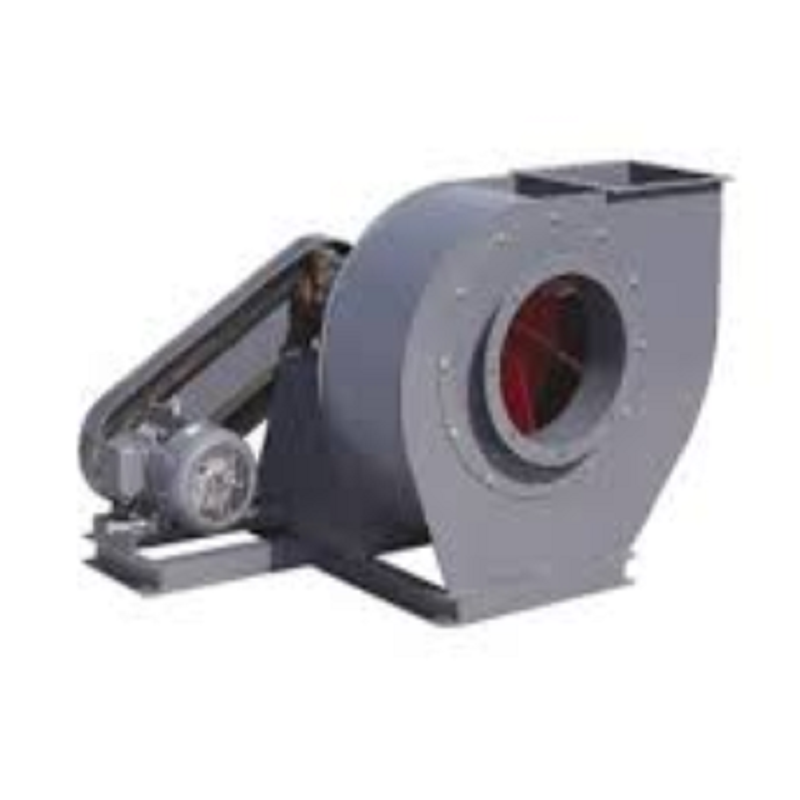
A boiler induced draft fan is one of those pieces of equipment that can look simple on a specification sheet and become surprisingly difficult once it is installed. The fan has to move hot flue gas through the boiler, dust collector, ductwork, and sometimes desulfurization equipment while keeping the furnace under the required negative pressure. In practice, selecting a boiler induced draft fan is therefore not just a matter of matching airflow. Fan pressure, gas temperature, dust concentration, system resistance, operating range, and motor power all have to be considered together.
The first step when selecting a boiler induced draft fan is to establish the real operating point of the boiler rather than relying on the nominal fan capacity. Required airflow should normally be calculated from boiler load, excess-air requirements, flue gas temperature, fuel characteristics, and the complete gas-handling system.
For example, consider an industrial boiler requiring approximately 50,000 m³/h of flue gas at an operating temperature of 150°C. If the calculated system resistance is 3,500 Pa, the fan should be selected around the actual operating point of 50,000 m³/h and 3,500 Pa, with a reasonable operating margin.
A common mistake is to select a boiler induced draft fan based only on the 50,000 m³/h airflow. If the actual system resistance is higher than expected, the fan may operate far away from its design point. The result can be insufficient furnace draft, unstable combustion, excessive vibration, or higher motor power consumption.
For a boiler induced draft fan, system pressure is often the parameter that determines whether the installation will perform properly. Total resistance may come from the boiler gas passages, economizer, air preheater, dust collector, ductwork, dampers, scrubber, and chimney.
During selection, these pressure losses should be added together instead of estimating them from the boiler alone. If the boiler and heat-recovery equipment account for 1,200 Pa, the dust collector requires 900 Pa, the wet flue gas treatment system requires another 800 Pa, and the ductwork and fittings contribute approximately 600 Pa, the fan must overcome roughly 3,500 Pa before any additional design allowance is considered.
This is where a properly selected boiler induced draft fan makes a noticeable difference. A fan with excessive pressure capability may consume unnecessary power, while a fan with insufficient pressure may never deliver the required airflow.
Flue gas temperature is another parameter that should never be treated as an afterthought. A boiler induced draft fan handling gas at 180°C operates under very different conditions from a ventilation fan handling air at 20°C.
High-temperature operation affects gas density, shaft cooling, bearing temperature, sealing arrangements, and motor loading. The fan manufacturer therefore needs to know the normal operating temperature as well as the possible maximum temperature.
For example, if the normal gas temperature is 140°C but the boiler can temporarily produce gas at 190°C during abnormal operating conditions, the boiler induced draft fan should be checked against the higher temperature. Shaft and bearing arrangements may also require additional cooling measures depending on the fan design and installation configuration.
In many industrial boilers, dust is a more serious problem than temperature. Fly ash and unburned particles can gradually erode the impeller, particularly when the fan operates at high peripheral speed.
A boiler induced draft fan installed downstream of a dust collector generally experiences less dust loading than one installed before the collector. Even so, the remaining particle concentration, particle size, hardness, and operating hours should be considered when selecting the impeller material and thickness.
One practical approach is to inspect the impeller during scheduled shutdowns and measure blade thickness at several fixed locations. If the original blade thickness is 8 mm and repeated inspections show a reduction to 6.5 mm in the same high-wear area, the wear rate can be tracked rather than waiting for visible deformation or cracking. For abrasive applications, wear-resistant liners or reinforced blade sections can extend the service interval of a boiler induced draft fan.
A boiler induced draft fan can continue running even when its impeller has accumulated several kilograms of ash, but that does not mean it is operating normally. Uneven deposits change the rotating mass distribution and can generate significant vibration.
For this reason, impeller dynamic balancing should be treated as a basic manufacturing and maintenance requirement. After cleaning, the impeller should also be inspected for cracks, deformation, corrosion, and loose wear plates.
In one typical maintenance situation, vibration gradually increased after several months of operation. The motor, bearings, and coupling were initially suspected. After removing the inspection door, technicians found uneven ash accumulation on one side of the impeller. Cleaning the deposits and correcting the balance brought the vibration back to an acceptable level without replacing the motor or bearings. This illustrates why diagnosing a boiler induced draft fan should begin with the rotating assembly rather than automatically replacing expensive components.
Motor selection for a boiler induced draft fan should be based on shaft power at the actual operating point, with an appropriate service margin. Simply installing a much larger motor does not solve an incorrectly selected fan.
Suppose a fan requires approximately 55 kW at its rated operating point. A motor may be selected with a suitable margin according to the operating conditions and applicable standards. However, if the fan is operated at a significantly higher airflow because of an incorrect damper setting or system modification, the required power can rise considerably.
This is particularly important when a fan is controlled by a damper. Throttling can change the operating point and system resistance, but it does not necessarily provide the same energy-saving effect as variable-speed control. Where boiler load changes significantly throughout the day, a properly configured VFD can make a boiler induced draft fan more responsive to actual demand.
Many boilers do not operate continuously at full load. A boiler may run at 100% load during peak production and drop to 60–70% load during quieter periods. Keeping the boiler induced draft fan at full speed and relying heavily on dampers can result in unnecessary power consumption.
Fan affinity laws provide a useful reference: for a given fan and system, airflow is approximately proportional to speed, pressure is proportional to the square of speed, and power is approximately proportional to the cube of speed. These relationships mean that even a moderate reduction in speed can produce a significant reduction in theoretical fan power.
For example, reducing fan speed from 100% to 80% gives an approximate theoretical power ratio of 0.8³ = 0.512, or about 51% of the original power under the corresponding affinity-law conditions. Actual savings depend on the system curve, fan efficiency, motor efficiency, and control strategy, but the example shows why variable-speed control can be attractive for a boiler induced draft fan with fluctuating demand.
A maintenance program for a boiler induced draft fan should not rely only on visual inspections. Operators should record vibration, bearing temperature, motor current, fan speed, furnace pressure, airflow where available, and operating temperature.
The value comes from comparing current readings with previous readings. For example, if bearing temperature normally remains around 65°C but gradually increases to 78°C without a corresponding change in ambient conditions or load, the trend deserves investigation. Similarly, a gradual increase in motor current at the same fan speed and boiler load may indicate increased system resistance, impeller fouling, or another operating problem.
Regular inspection of the impeller, shaft, bearings, coupling, expansion joints, dampers, and flexible connections can prevent small problems from developing into major failures. For a boiler induced draft fan operating continuously, planned shutdown inspections are usually much easier to manage than emergency repairs during production.
Consider a 35-ton-per-hour industrial boiler where the existing fan was rated for approximately 80,000 m³/h at 4,000 Pa. Operators reported that furnace pressure became unstable when the boiler approached full load. Motor current was also close to the rated value.
Instead of immediately replacing the boiler induced draft fan, the operating data was checked first. Inspection showed that the dust collector pressure drop had increased because of fouling, while the fan impeller had accumulated deposits. The combined effect increased system resistance and moved the fan away from its original operating point.
After cleaning the dust collector, removing deposits from the impeller, checking the damper position, and correcting the operating settings, the fan recovered much of its original performance. This type of diagnosis is important because not every apparent fan-capacity problem requires a new boiler induced draft fan.
Replacement becomes more reasonable when the existing fan cannot meet the required operating point even after the system has been inspected and corrected. Typical reasons include a major boiler capacity upgrade, installation of additional flue gas treatment equipment, increased system pressure loss, severe impeller wear, or a fundamental mismatch between the original fan and the current process.
When replacing a boiler induced draft fan, the old fan's nameplate data should not simply be copied into the new specification. The current boiler load, gas temperature, system resistance, dust concentration, operating hours, and control requirements should be reassessed.
A well-designed replacement can also address problems that were accepted as normal with the old equipment. For example, a fan may be redesigned with a more suitable impeller profile, improved wear protection, better bearing cooling, or VFD control. These changes can improve both reliability and operating cost.
Before ordering a boiler induced draft fan, I would verify at least the following:
Required airflow at normal and maximum boiler load
Static or total pressure at the fan inlet/outlet
Normal and maximum flue gas temperature
Flue gas density or operating pressure
Dust concentration and particle characteristics
Gas composition and potential corrosion
Fan installation altitude
Fan rotation direction
Required fan speed
Motor voltage and frequency
Motor power and starting method
VFD or damper control requirements
Bearing arrangement and cooling method
Impeller material and wear protection
Shaft and coupling requirements
Required maintenance access
These details provide a much more reliable basis for selecting a boiler induced draft fan than airflow alone.
A high-efficiency boiler induced draft fan is not simply a large centrifugal fan connected to a boiler outlet. Its performance depends on how accurately the fan matches the complete flue gas system. Airflow, pressure, temperature, dust loading, impeller design, motor power, and control strategy all influence the final result.
For new boiler projects, the best approach is to calculate the complete system resistance and select the fan around the actual operating point. For existing installations, operating data and maintenance history should be reviewed before deciding that the fan itself is undersized.
When these factors are addressed together, a boiler induced draft fan can maintain stable furnace draft, reduce unnecessary energy consumption, improve equipment reliability, and provide a longer service life under demanding industrial operating conditions.